
Retatrutide: What It Is and Where the Research Stands
Retatrutide is an investigational medicine being developed by Eli Lilly for obesity, type 2 diabetes and related health conditions. It activates three hormone receptors—GIP, GLP-1 and glucagon—which is why it is often called a "triple agonist."
Clinical trials have reported substantial changes in body weight and blood-glucose measures. Retatrutide nevertheless remains unapproved, does not have a regulator-approved product label, and is legally available from Lilly only to participants in its clinical trials.
At a glance
- Other name: LY3437943; sometimes shortened online to "reta."
- What it is: An investigational GIP, GLP-1 and glucagon receptor agonist.
- Main research areas: Obesity, overweight with related conditions, type 2 diabetes and several weight-related complications.
- Strongest evidence: Peer-reviewed Phase 2 obesity research, a peer-reviewed Phase 3 type 2 diabetes trial, and sponsor-reported Phase 3 obesity results awaiting full peer-reviewed publication.
- FDA status: Not approved. FDA states that retatrutide has not been found safe and effective for any condition and cannot be used in compounding under US federal law.
- Australian status: Unapproved and named in a June 2026 TGA public-health warning concerning unapproved peptide products.
- Evidence reviewed: 17 July 2026.
Important: This page summarises published research and regulatory information. It is not medical advice, does not recommend using retatrutide, and does not provide a dose or treatment protocol.
What is retatrutide?
Retatrutide is a single experimental molecule designed to activate three receptors involved in metabolism and appetite regulation:
- GLP-1 receptor: associated with glucose-dependent insulin release, slower gastric emptying and appetite regulation;
- GIP receptor: involved in insulin signalling and energy metabolism;
- Glucagon receptor: involved in glucose regulation, energy use and liver metabolism.
Approved medicines already target GLP-1 alone or GLP-1 and GIP together. Retatrutide adds glucagon-receptor activity. That scientific difference is important, but having three targets does not automatically make a medicine safer, more effective or better suited to an individual.
Only completed clinical trials and regulatory review can establish its benefit-risk profile for a particular use.
History and development
Early clinical development
Retatrutide was initially known by its development code, LY3437943. Early studies evaluated its effects on blood glucose, body weight, tolerability and pharmacology in people with and without type 2 diabetes.
Phase 2 results in 2023
A randomized Phase 2 obesity trial published in the New England Journal of Medicine in 2023 brought retatrutide broad attention. In the highest-dose trial group, mean weight change reached 24.2% after 48 weeks. The result was an average from a controlled research population, not a forecast for an individual.
A separate Phase 2 study in people with type 2 diabetes examined blood-glucose control and weight change. These studies supported further development but were not sufficient for approval.
Expansion into Phase 3
Lilly launched a broad Phase 3 programme covering obesity, type 2 diabetes and several related conditions. Registered studies have examined or are examining knee osteoarthritis pain, sleep apnoea, cardiovascular and kidney outcomes, liver disease and chronic low-back pain in defined populations.
Phase 3 evidence in 2026
In June 2026, The Lancet published TRANSCEND-T2D-1, a 40-week Phase 3 trial involving 537 adults whose type 2 diabetes was inadequately controlled with diet and exercise alone. Retatrutide groups had larger average reductions in HbA1c and body weight than placebo. The study was funded by Lilly, and several authors were company employees or shareholders.
On 21 May 2026, Lilly announced positive topline findings from TRIUMPH-1, its Phase 3 obesity trial. The company highlighted average weight reduction of up to 28.3% at 80 weeks in one prespecified analysis of the highest-dose group. Another reported analysis produced a lower estimate. Full interpretation requires the complete methods, all endpoints and peer-reviewed publication.
How researchers think retatrutide works
Retatrutide combines three receptor activities in one molecule.
GLP-1 and GIP receptor activity may affect appetite, food intake and glucose-dependent insulin responses. Glucagon receptor activity may influence energy expenditure and liver metabolism. Researchers designed the combination to test whether these pathways could produce clinically useful effects on weight and metabolic health.
The mechanism is more complex than "three hormones burn more fat." The same pathways can affect several organs and physiological systems. Clinical trials are therefore measuring both potential benefits and adverse effects across different populations and durations.
What is retatrutide being studied for?
Obesity and overweight
The largest public interest concerns weight management. Phase 2 research and sponsor-reported Phase 3 data show substantial average weight reductions in selected trial populations receiving structured follow-up.
Those figures should not be compared directly with percentages from unrelated trials of other medicines. Differences in participant criteria, duration, analysis methods, adherence and missing-data handling can change the result.
Type 2 diabetes
TRANSCEND-T2D-1 provides peer-reviewed Phase 3 evidence in adults with type 2 diabetes inadequately controlled by diet and exercise. At 40 weeks, mean HbA1c reductions ranged from 1.69 to 1.94 percentage points across retatrutide groups, compared with 0.81 points with placebo. Mean weight changes ranged from 11.5% to 15.3%, compared with 2.6% with placebo.
These results apply to the studied population and trial conditions. Retatrutide still requires regulatory review before it can become an approved diabetes treatment.
Weight-related joint symptoms
TRIUMPH-4 studied adults with obesity or overweight and knee osteoarthritis. Weight change and knee-pain measures were co-primary outcomes. The trial helps researchers test whether substantial weight reduction is accompanied by improvements in symptoms and physical function; it does not establish retatrutide as a general pain medicine.
Other cardiometabolic conditions
Lilly's Phase 3 programme includes defined studies involving obstructive sleep apnoea, cardiovascular and kidney outcomes, metabolic liver disease and chronic low-back pain. Inclusion in a development programme means a question is being tested. It does not mean the medicine has been proven or approved for that condition.
What could retatrutide potentially help with?
Retatrutide may eventually become a treatment option for obesity, type 2 diabetes or particular weight-related conditions if regulators determine that its benefits outweigh its risks for defined patient groups.
Evidence is more advanced than it is for many peptides discussed online: retatrutide has large controlled human trials and peer-reviewed Phase 3 diabetes data. However, the correct description remains "investigational." It is not yet an approved treatment that a consumer can safely self-select.
| Research area | Evidence available | Main finding | What remains unknown |
|---|---|---|---|
| Obesity without diabetes | Peer-reviewed Phase 2 trial; large Phase 3 sponsor topline results | Substantial average weight reduction under trial conditions | Full peer-reviewed Phase 3 analysis, long-term benefit-risk balance and approved patient population |
| Type 2 diabetes | Peer-reviewed Phase 2 and Phase 3 randomized trials | Improved average HbA1c and body-weight measures versus placebo in studied populations | Regulatory conclusions, longer-term outcomes and position relative to approved treatments |
| Knee osteoarthritis with obesity or overweight | Completed Phase 3 study with weight and pain outcomes | Research examines both weight change and knee symptoms | How much symptom change is directly attributable to weight loss, durability and any approved indication |
| Sleep apnoea and other weight-related conditions | Phase 3 development programme | Condition-specific outcomes are being tested | Whether trials will demonstrate clinically meaningful benefit and acceptable safety |
| Cardiovascular, kidney and liver outcomes | Ongoing or planned late-stage research | Designed to test outcomes beyond body weight alone | Long-term event data and regulator assessment |
Obesity without diabetes
- Evidence available
- Peer-reviewed Phase 2 trial; large Phase 3 sponsor topline results
- Main finding
- Substantial average weight reduction under trial conditions
- What remains unknown
- Full peer-reviewed Phase 3 analysis, long-term benefit-risk balance and approved patient population
Type 2 diabetes
- Evidence available
- Peer-reviewed Phase 2 and Phase 3 randomized trials
- Main finding
- Improved average HbA1c and body-weight measures versus placebo in studied populations
- What remains unknown
- Regulatory conclusions, longer-term outcomes and position relative to approved treatments
Knee osteoarthritis with obesity or overweight
- Evidence available
- Completed Phase 3 study with weight and pain outcomes
- Main finding
- Research examines both weight change and knee symptoms
- What remains unknown
- How much symptom change is directly attributable to weight loss, durability and any approved indication
Sleep apnoea and other weight-related conditions
- Evidence available
- Phase 3 development programme
- Main finding
- Condition-specific outcomes are being tested
- What remains unknown
- Whether trials will demonstrate clinically meaningful benefit and acceptable safety
Cardiovascular, kidney and liver outcomes
- Evidence available
- Ongoing or planned late-stage research
- Main finding
- Designed to test outcomes beyond body weight alone
- What remains unknown
- Long-term event data and regulator assessment
What did the major trials report?
Phase 2 obesity trial
The 2023 randomized, double-blind trial included adults with obesity, or overweight plus at least one weight-related condition, without diabetes. At 48 weeks, the highest-dose group had a mean weight reduction of 24.2%.
Gastrointestinal adverse events were the most common. They occurred mainly while doses were being increased, were generally mild to moderate and were more frequent in higher-dose groups. Heart rate increased in a dose-dependent pattern up to 24 weeks and then declined later in the trial.
TRANSCEND-T2D-1 Phase 3 diabetes trial
The 2026 trial randomized 537 adults to three retatrutide groups or placebo for 40 weeks. Retatrutide produced larger mean improvements in HbA1c and body weight. The most frequent adverse events were gastrointestinal and generally mild to moderate. Treatment discontinuation because of adverse events occurred in 2% to 5% of retatrutide participants and 0% of placebo participants. No severe hypoglycaemia was reported.
Two deaths occurred in one retatrutide group; the investigators reported that both were unrelated to the study drug. Reporting that assessment does not remove the need for broader safety evaluation.
TRIUMPH-1 Phase 3 obesity announcement
Lilly's May 2026 announcement described positive results from 2,339 participants studied for 80 weeks. The company reported substantial average weight reductions across all retatrutide groups.
The most common events reported by Lilly were nausea, diarrhoea, constipation and vomiting. Dysesthesia—altered or unusual sensation—was also reported more often with retatrutide than placebo. Discontinuation due to adverse events increased across the reported dose groups.
These are sponsor-reported topline results. Detailed presentation and peer-reviewed publication are needed for independent evaluation of the full dataset.
Current approval and regulatory status
United States
Retatrutide is not FDA approved. The FDA states that retatrutide is not a component of an FDA-approved drug and has not been found safe and effective for any condition.
The FDA also states that retatrutide cannot be used in compounding under US federal law. It is not eligible merely because a seller calls it "research use only," "custom," or a compounded GLP-1 product.
Australia
Retatrutide is not included in the Australian Register of Therapeutic Goods as an approved medicine. On 19 June 2026, the TGA and Australia's Chief Medical Officer identified retatrutide among unapproved peptide products of public-health concern.
The TGA warning emphasises that unapproved products have not been evaluated for safety, quality or effectiveness and may have uncertain ingredients, labelling, manufacturing conditions and sterility.
Clinical-trial access
Lilly states that retatrutide is legally available only to participants in its clinical trials. A product sold online under the same name is not equivalent to participation in a regulated trial, where product quality, eligibility, monitoring and adverse-event reporting are controlled.
Known side effects and important uncertainties
Side effects reported across retatrutide trials include:
- nausea;
- diarrhoea;
- constipation;
- vomiting;
- altered or unusual sensations reported as dysesthesia in TRIUMPH-1;
- dose-related increases in heart rate observed in Phase 2 research.
The frequency and severity varied by trial group and study. Trial findings do not establish that an unapproved online product has the same composition, purity or risk profile as Lilly's investigational medicine.
Important uncertainties remain:
- rare adverse effects that require larger or longer studies to detect;
- long-term cardiovascular and kidney outcomes;
- durability after treatment is stopped;
- safety in populations not represented in the trials;
- interactions and contraindications that regulators may ultimately place in approved labelling;
- whether every proposed indication will show a favourable benefit-risk balance.

Timeline from early clinical studies through 2023 Phase 2 peer review, 2025 TRIUMPH-4 completion, May–June 2026 TRIUMPH-1 sponsor topline and TRANSCEND peer review, remaining investigational as of 17 July 2026.
Source: /peptides/retatrutide. SVG · PNG
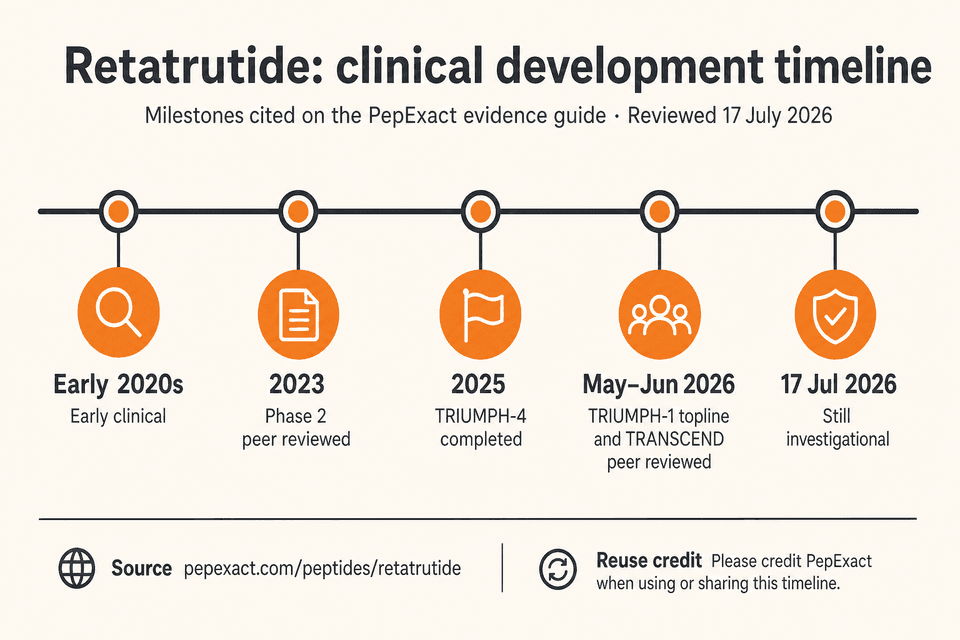
Publishers may reuse this graphic with a visible source credit to PepExact. Please link to the original evidence page so readers can inspect the sources and current status.
Retatrutide clinical evidence tracker
| Study | Population | Phase | Status at review date | Evidence availability | Primary source |
|---|---|---|---|---|---|
| Phase 2 obesity trial (NEJM 2023) | Adults with obesity, or overweight plus at least one weight-related condition, without diabetes | Phase 2 | Completed | Peer reviewed | Phase 2 obesity trial, New England Journal of Medicine |
| TRANSCEND-T2D-1 | Adults with type 2 diabetes inadequately controlled with diet and exercise alone (n=537) | Phase 3 | Completed | Peer reviewed | TRANSCEND-T2D-1 Phase 3 trial, The Lancet, indexed by PubMed |
| TRIUMPH-1 | Adults in Phase 3 obesity programme (n=2,339 reported by sponsor) | Phase 3 | Topline announced 21 May 2026 | Sponsor topline | Lilly: TRIUMPH-1 Phase 3 topline results, 21 May 2026 |
| TRIUMPH-1 registry | Obesity / overweight research population (registry record) | Phase 3 | Registry record | Registry record | ClinicalTrials.gov: TRIUMPH-1 |
| TRIUMPH-4 | Obesity or overweight with knee osteoarthritis | Phase 3 | Completed (2025) | Registry record | ClinicalTrials.gov: TRIUMPH-4 |
| TRIUMPH-8 | Defined Phase 3 research population (registry) | Phase 3 | Registry record | Registry record | ClinicalTrials.gov: TRIUMPH-8 |
Phase 2 obesity trial (NEJM 2023)
- Population
- Adults with obesity, or overweight plus at least one weight-related condition, without diabetes
- Phase
- Phase 2
- Status at review date
- Completed
- Evidence availability
- Peer reviewed
- Primary source
- Phase 2 obesity trial, New England Journal of Medicine
TRANSCEND-T2D-1
- Population
- Adults with type 2 diabetes inadequately controlled with diet and exercise alone (n=537)
- Phase
- Phase 3
- Status at review date
- Completed
- Evidence availability
- Peer reviewed
TRIUMPH-1
- Population
- Adults in Phase 3 obesity programme (n=2,339 reported by sponsor)
- Phase
- Phase 3
- Status at review date
- Topline announced 21 May 2026
- Evidence availability
- Sponsor topline
- Primary source
- Lilly: TRIUMPH-1 Phase 3 topline results, 21 May 2026
TRIUMPH-1 registry
- Population
- Obesity / overweight research population (registry record)
- Phase
- Phase 3
- Status at review date
- Registry record
- Evidence availability
- Registry record
- Primary source
- ClinicalTrials.gov: TRIUMPH-1
TRIUMPH-4
- Population
- Obesity or overweight with knee osteoarthritis
- Phase
- Phase 3
- Status at review date
- Completed (2025)
- Evidence availability
- Registry record
- Primary source
- ClinicalTrials.gov: TRIUMPH-4
TRIUMPH-8
- Population
- Defined Phase 3 research population (registry)
- Phase
- Phase 3
- Status at review date
- Registry record
- Evidence availability
- Registry record
- Primary source
- ClinicalTrials.gov: TRIUMPH-8
Evidence update log
- 17 July 2026 — Initial evidence review published using regulator, anti-doping, trial-registry and peer-reviewed sources.
Research timeline
Early 2020s
Initial clinical studies examine retatrutide's pharmacology, glucose effects, body-weight effects and tolerability.
2023
Peer-reviewed Phase 2 obesity and type 2 diabetes trials are published.
2023 onward
Lilly expands the TRIUMPH and TRANSCEND Phase 3 programmes.
2025
TRIUMPH-4, involving obesity or overweight and knee osteoarthritis, is completed.
21 May 2026
Lilly announces positive topline TRIUMPH-1 Phase 3 obesity results.
6 June 2026
Peer-reviewed TRANSCEND-T2D-1 Phase 3 diabetes results are published online by The Lancet.
19 June 2026
The TGA and Australia's Chief Medical Officer include retatrutide in a warning concerning unapproved peptide products.
17 July 2026
Retatrutide remains investigational and unapproved while additional Phase 3 studies and regulatory development continue.
Frequently asked questions
What is retatrutide?
Retatrutide, or LY3437943, is an investigational medicine that activates GIP, GLP-1 and glucagon receptors. Lilly is developing it for obesity, type 2 diabetes and related conditions.
Is retatrutide approved by the FDA?
No. The FDA says retatrutide has not been found safe and effective for any condition and is not a component of an FDA-approved drug.
What is retatrutide being studied for?
Its clinical programme includes obesity, overweight with related medical conditions, type 2 diabetes, knee osteoarthritis symptoms, sleep apnoea, cardiovascular and kidney outcomes, liver disease and chronic low-back pain in defined research populations.
How is retatrutide different from semaglutide and tirzepatide?
Semaglutide targets the GLP-1 receptor. Tirzepatide targets GIP and GLP-1 receptors. Retatrutide targets GIP, GLP-1 and glucagon receptors. That mechanistic difference does not prove superiority, and results from separate trials should not be treated as direct comparisons.
What did the obesity trials report?
A peer-reviewed Phase 2 trial reported a 24.2% mean weight reduction after 48 weeks in its highest-dose group. Lilly later reported Phase 3 TRIUMPH-1 results highlighting up to 28.3% mean reduction at 80 weeks in one analysis. Those are group averages from controlled trials, not expected individual results, and the Phase 3 obesity findings still require full peer-reviewed publication.
What side effects have been reported?
The most frequently reported effects have been gastrointestinal, including nausea, diarrhoea, constipation and vomiting. Trials have also reported dysesthesia and changes in heart rate. The complete safety profile is not yet established.
Can retatrutide legally be compounded in the United States?
The FDA states that retatrutide cannot be used in compounding under US federal law.
Is "reta peptide" the same as retatrutide?
"Reta" and "reta peptide" are informal online names commonly used for retatrutide. A vial carrying that label is not proof that it contains Lilly's investigational medicine or meets clinical-trial manufacturing standards.
Can retatrutide be purchased outside a clinical trial?
Lilly states that its investigational retatrutide is legally available only to clinical-trial participants. PepExact does not provide suppliers or purchasing guidance. Consumers should be cautious of websites marketing unapproved products and consult licensed health professionals and official trial registries.
Cite this page
- Title
- Retatrutide: What It Is and Where the Research Stands
- Publisher
- PepExact
- Published
- 2026-07-17
- Last reviewed
- 17 July 2026
- Canonical URL
- https://pepexact.com/peptides/retatrutide
PepExact. (2026-07-17). Retatrutide: What It Is and Where the Research Stands. https://pepexact.com/peptides/retatrutide. Evidence last reviewed 17 July 2026.
Sources and further reading
- FDA: concerns with unapproved GLP-1 drugs, including retatrutide
- TGA and Australian Chief Medical Officer: unapproved peptide products, 19 June 2026
- Phase 2 obesity trial, New England Journal of Medicine
- TRANSCEND-T2D-1 Phase 3 trial, The Lancet, indexed by PubMed
- Lilly: TRIUMPH-1 Phase 3 topline results, 21 May 2026
- ClinicalTrials.gov: TRIUMPH-1
- ClinicalTrials.gov: TRIUMPH-4
- ClinicalTrials.gov: TRIUMPH-8
Researcher, clinician or journalist? If you spot a source update or need the underlying citation list, contact PepExact.
Related measurement tool
Retatrutide calculator
Already have independently supplied measurement inputs? The retatrutide calculator performs unit arithmetic only. It does not recommend an amount, product or protocol.